While it is obvious why the Canal would require Stone Masons, Blacksmiths and Laborers, it is not so clear why there would be a need for carpenters. However, in Daniel Hoard’s work crew assigned to the Deep Cut area between Lakes Micmac and Charles in the community we now know as Port Wallace, there were no fewer than ten carpenters. Three of whom were named John – John Beggs, John Whelan and John Wolfe. Might one of these be a relative of yours? When the first canal attempt failed in 1831 it is very likely these folks found work in the community and may have had a hand in the construction of some of the houses we still see standing on both sides of our harbour.
-Bernie Hart
canal worker_kennedy Is your last name Kennedy? If so, you may have been related to one of the Canal workers.

One of the tragedies we read about in the Canal village at Port Wallace had to do with a lightning strike on one of the cottages. In this case the victim was Mr. Kennedy, a carpenter. It was late at night when the lightning occurred, apparently striking Kennedy and throwing him from his bunk. The others in the home were unable to revive him. When you next visit the park you can see the stone walls on the site where we believe this occurred. There is a sign marking the location on the west side of the Canal between Locks 2 and 3. Once again we are hoping someone will be able to identify this man as a relative. If you do, please let us know.
-Bernie Hart
Fibreglass replica of a Mi’maq birchbark canoe hangs in the Fairbanks Centre.
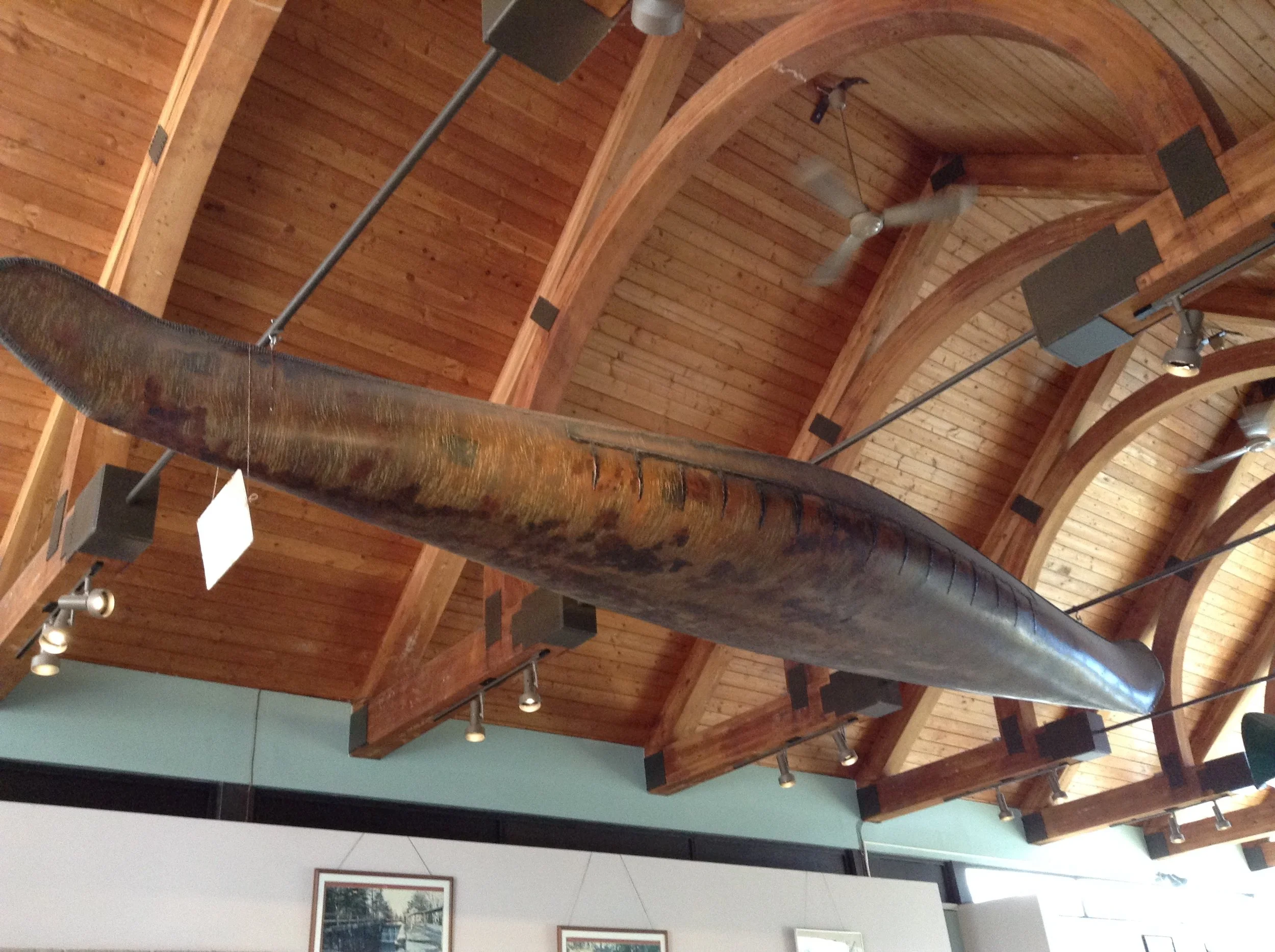
As indicated in a previous article a second canoe has been hung from the ceiling of the Fairbanks Centre. The first one which was hung several years ago is a fibreglass replica of a Mi’maq birchbark canoe. The original bark version, after which this was patterned was a birch bark canoe constructed by a member of the Mi’kmaq community. This fibreglass craft was constructed in the 1990s for the CBC to be used in the videotaping of a series of four programs on Mi’kmaq history which were used in schools.
It is important to realize the birch bark canoe, which was invented by the North American First Nations, was unknown in the rest of the world and without it the exploration of this Continent by the Europeans would have been next to impossible. The bark or skin canoes were developed over the course of thousands of years by the natives of North America. Champlain writes of his journey to the Great Lakes. “There is no craft known to the Europeans except the canoe of birch bark with which the journey to the Upper Country can be made…”.
-Bernie Hart
Thanks to Bill Moore, the Avery Model is now operational again!
The Avery was the first vessel to make the complete journey from Dartmouth Cove to Maitland. This historic journey took place in the fall of 1861. It was then used to tow barges along the route of the Canal. As you can see from the photos the Avery was a steam powered side-paddle wheeler. She was built at Porto Bello adjacent to the Marine Rail system which transported vessels between lakes William and Charles. This system was completed and in operation before the downtown Dartmouth Marine Railway was complete.
Thank you to Bill Moore, Maritime Ship Modelers Guild, for repairing the working model of the Avery which is on display at the Fairbanks Centre. The model was originally constructed by Robert Payne and Michael Concannon, members of Maritime Ship Modelers Guild. The Commission is most grateful for the contributions these gentlemen have made.
-Bernie Hart


Sketch of the Avery

Avery Model in the Holding Pond by the Fairbanks Centre in 2006